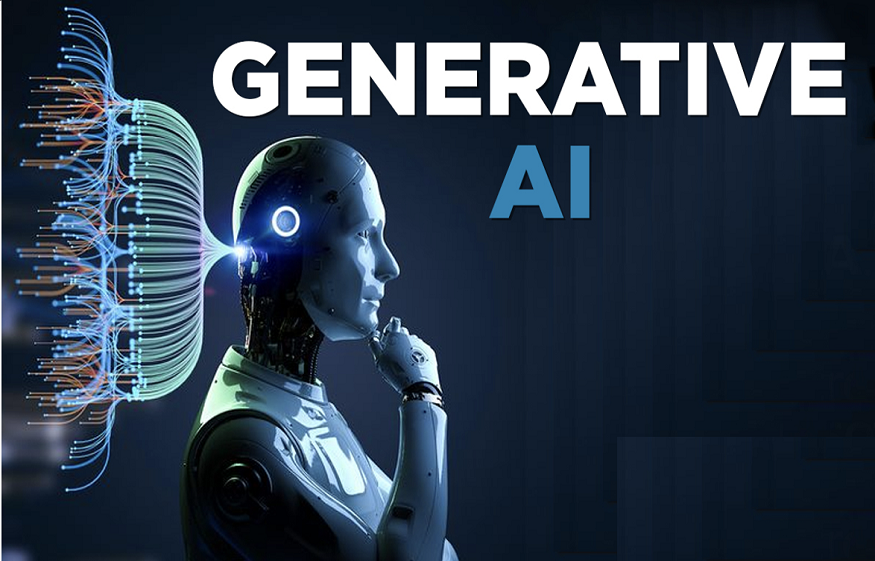
In today’s fast-paced digital landscape, Generative AI has emerged as a groundbreaking technology, reshaping how businesses, creatives, and everyday users approach problem-solving and content creation. Unlike traditional AI that primarily analyzes existing data, Generative AI goes a step further — it creates new content, designs, and ideas from scratch, opening up possibilities that were previously unimaginable. From producing realistic images and videos to drafting text and even composing music, this technology is revolutionizing the way we work, communicate, and innovate.
What is Generative AI?
At its core, Generative AI refers to a subset of artificial intelligence that can generate new data based on the patterns and structures it has learned from existing datasets. These systems use models like Generative Adversarial Networks (GANs), Variational Autoencoders (VAEs), and large language models (LLMs) to understand and replicate complex patterns, enabling them to produce outputs that are often indistinguishable from human-created work.
Read More : Are App-Based Loans Really as Simple as They Seem?
The applications are vast: from designing hyper-realistic graphics for video games and virtual reality to producing highly personalized marketing content, Generative AI empowers creators and businesses to achieve more in less time.
Key Applications of Generative AI
- Content Creation
Writers, designers, and marketers are using Generative AI tools to draft articles, scripts, social media posts, and advertisements. These systems can even suggest stylistic tweaks and generate multiple versions of content, saving hours of work while enhancing creativity.
- Art and Design
Artists and designers can leverage AI to produce unique illustrations, 3D models, and digital art. Platforms powered by Generative AI allow experimentation with new styles, colors, and concepts that might have taken weeks to create manually.
- Healthcare and Drug Discovery
In medicine, Generative AI models analyze molecular structures and predict new drug candidates, potentially accelerating research and reducing costs. The ability to simulate biological interactions can lead to faster breakthroughs in treatments and therapies.
- Entertainment and Media
The entertainment industry benefits from AI-generated scripts, music, and even video game environments. By automating parts of the creative process, studios can experiment with new narratives and immersive experiences without stretching budgets.
- Business and Marketing
Businesses use Generative AI to create personalized campaigns, product recommendations, and predictive analytics. The technology enables highly tailored customer experiences that can increase engagement and conversion rates.
How Generative AI Works
Generative AI models typically learn from large datasets, identifying patterns, relationships, and features in the data. For example, in text generation, an AI system analyzes grammar, tone, and context from thousands of documents. In image generation, it learns pixel patterns and visual structures. Once trained, the AI can produce entirely new outputs that align with the learned patterns.
Two popular methods are:
- Generative Adversarial Networks (GANs): A GAN consists of two neural networks — a generator and a discriminator — that work in tandem. The generator creates new data, while the discriminator evaluates its authenticity, continuously improving the quality of the output.
- Large Language Models (LLMs): LLMs, such as GPT variants, are trained on vast amounts of text to understand language patterns. They can generate coherent, contextually accurate text for a variety of purposes, from essays to technical documentation.
Benefits of Generative AI
- Enhanced Creativity: Automates repetitive tasks while providing new ideas and solutions.
- Efficiency: Reduces time and effort in content creation and design processes.
- Cost Savings: Minimizes the need for extensive manual labor in creative and research-heavy industries.
- Personalization: Generates tailored content that resonates with specific audiences.
- Innovation Acceleration: Opens doors to novel products, solutions, and experiences.
Challenges and Considerations
While Generative AI offers immense potential, it also comes with challenges:
- Ethical Concerns: AI-generated content can blur the line between human and machine creations, raising questions about authenticity and copyright.
- Bias and Fairness: AI models may replicate biases present in training data, affecting output quality and fairness.
- Misinformation: Generative AI can create realistic fake media, making misinformation harder to detect.
- Resource Intensive: Training complex models requires significant computational power and energy consumption.
The Future of Generative AI
Generative AI is still evolving, and its future promises even more exciting possibilities. We can expect more advanced models capable of understanding context deeply, generating highly realistic and interactive media, and collaborating seamlessly with humans in creative and analytical workflows. Industries like education, architecture, entertainment, and healthcare are poised to benefit the most from these advancements.
Read More : Innovative Testing Solutions: The Importance of HCL Corrosion Noxious Gas Chambers
Moreover, the integration of Generative AI with other emerging technologies like augmented reality, virtual reality, and the Internet of Things (IoT) will unlock new immersive experiences and smart solutions, making our interaction with technology more intuitive and dynamic than ever.
Final Thoughts
Generative AI is more than a technological trend; it’s a paradigm shift in creativity, innovation, and productivity. By combining human ingenuity with machine intelligence, it allows us to explore new frontiers and redefine what’s possible across industries. While challenges remain, responsible implementation and ethical practices can ensure that the benefits far outweigh the risks. As Generative AI continues to evolve, staying informed and adapting to its capabilities will be key for businesses, creators, and individuals eager to harness its transformative potential.